Cooked; Brutalist; USB-C[ruft]
A new year brings with it a chance to streamline and simplify many things, including items that touch on the digital side of life. Today we cover a couple of those (and one that definitely is not trending anywhere near “simple” or “streamlined”).
TL;DR
(This is an AI-generated summary of today’s Drop using Ollama + llama 3.2 and a custom prompt.)
USB-C cable complexity revealed through detailed analysis of various cables, from Apple’s premium Thunderbolt 4 Pro to budget options, showing significant differences in engineering and capabilities (https://www.stderr.nl/Blog/Hardware/Thunderbolt/TechnologyOverview.html)
Cooked.wiki transforms cluttered recipe websites into clean, interactive formats by prepending URLs with cooked.wiki, offering features like shopping lists and recipe sharing (https://cooked.wiki/landing)
The Brutalist Report delivers headlines without clutter across multiple categories, featuring minimal HTML/CSS design and optional AI summaries (https://brutalist.report/)
Cooked

I 💙 cooking; and, I 💙 dead tree cookbooks; but I 😡 almost every web page with a recipe, since influencer culture, SEO, and “profit” make most of them unusable.
Enter Cooked.wiki.
Cooked is an online platform designed to streamline our quest to collect #nom recipes by transforming cluttered recipe web pages and videos into clean, interactive formats. By simply prepending (see this Drop for more great prependers) https://cooked.wiki/ before any recipe URL, the site extracts essential information—ingredients and instructions — presenting it in a straighforward-yet-attractive-and-useful layout. This feature is particularly useful for recipes from blogs or video platforms like YouTube, TikTok, and Instagram, since it lets us focus on cooking without unnecessary distractions and inanae backstories.
Beyond simplifying individual recipes, Cooked.wiki offers tools to enhance meal preparation. It can deconstruct complex recipes into interactive sub-recipes, making intricate dishes more approachable. And, the platform provides a clever shopping list feature that consolidates ingredients from multiple recipes — even organizing them by supermarket aisle! to ensure efficient grocery trips.
Cooked is also a social cooking site where we can create public profiles to share our fav recipes with others, add personal notes, and explore culinary creations from across the Cooked community. The platform also suggests ingredient pairings based on what you have at home, which can be a blessing on an ill-prepared weeknight.
The service is accessible without registration and is free to use. However, creating an account unlocks additional features, such as the ability to save unlimited recipes, access smart shopping lists, and receive personalized recipe recommendations. For those seeking even more functionality, a patron plan (full disclosure: I subscribed) is available, offering benefits like converting recipes into printable PDFs, generating recipes from photos or documents, and using voice dictation to create recipes.
This was a great and welcome find at the start of 2025.
Brutalist
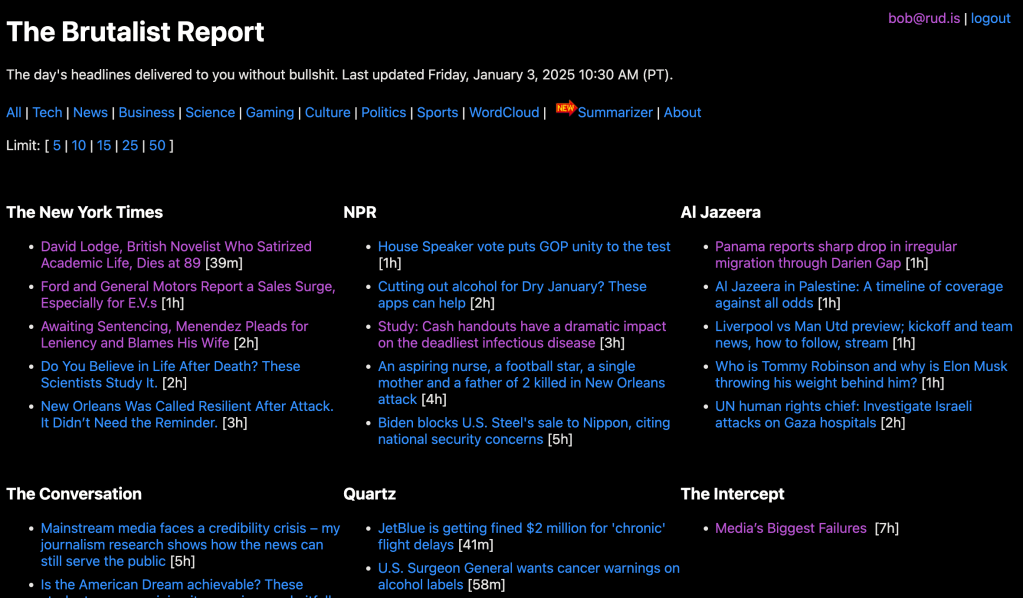
Long time readers know I’m a news addict and pull daily information from scads of sites.
A new one popped up on my radar right at the tail end of the year: The Brutalist Report, which tags itself as “The day’s headlines delivered to you without bull💩.”
Leaning into yesterday’s content a bit, this site is for folks who “want a simple, reliable, and performant online experience. Small web services that are built using simple HTML and CSS with no JavaScript or complex client-side processing.”
It has a decent number of top-level sections:
All | Tech | News | Business | Science | Gaming | Culture | Politics | Sports
the ability to limit articles-per-source to [ 5 | 10 | 15 | 25 | 50 ], a “word cloud” feature for premium members ($6.00 USD/month), and an AI summary (with paid plans having access to on-demand summaries).
The default sectioned headline view lets me “diff” what they show with what I’ve already triaged, and any stories I want to hit, I just right-click and select “Archive Link” (via) in my browser so I can be assured I’ll likely see the whole content vs a daft paywall.
I’ll likely write a thing which will ingest the headlines/links, get markdown from the articles through r.jina.ai, then provides text-only view with an AI-based summary.
We could use about 1,000 more services like this with a focus on function as well as form.
USB-C[ruft]

Full disclosure (again): this section is full of cruft.
USB-C was supposed to be the one USB cable to rule them all. No more twisting connectors to fit right. No more annual-ish required cable purchases to support a new standard. Nope. USB-C is the great, cruftless unifier.
Or, is it?
Matthijs Kooijman takes us on a very windy walk through the perilous terrain that is USB-C.
USB has evolved significantly since its inception. USB 1.0 and 2.0 utilized a single half-duplex pair, allowing data transfer rates up to 480 Mbps. The advent of USB 3.0 introduced two additional lines operating at 5 Gbps per line, forming a full-duplex channel with a total bandwidth of 10 Gbps. Subsequent versions, USB 3.1 and 3.2, further increased speeds, with USB 3.2 utilizing all four high-speed lines in a USB-C connection to achieve up to 40 Gbps total bandwidth.
That’s all well-and-good, but gosh wait til you read how much research it takes to ensure you’re getting the cables for the right connections.
Speaking of cables, not all USB-C cables are created equal. In October 2023 (it has only gotten worse since then), Lumafield conducted a detailed analysis of various USB-C cables, ranging from Apple’s premium Thunderbolt 4 Pro cable to more affordable options like Amazon Basics and other budget brands.
Apple’s Thunderbolt 4 Pro cable turns out to have some exceptional engineering. It supports data transfer speeds up to 40 Gb/s and delivers up to 100 W of power. The connector features a hard plastic enclosure with a stainless steel metal shield beneath, ensuring durability and effective shielding. Inside, it houses 24 pins, each independently mounted on a 10-layer printed circuit board assembly (PCBA). This intricate design facilitates high-speed data transmission and robust performance.
In contrast, the Amazon Basics USB-C to USB-C 2.0 Fast Charger Cable, priced significantly lower, offers charging up to 60 W and data transfer speeds up to 480 Mbps. Its construction includes a metal jacket beneath the plastic enclosure for shielding, integrated with a simpler strain relief mechanism. The connector contains 12 pins, half the number found in Apple’s cable, with some pins paired together, reflecting a design optimized for basic functionality and cost-effectiveness.
I won’t spoil the rest of the post (the pics from the industrial CT scanner are super cool!) and encourage all to give it a quick 👀
FIN
Remember, you can follow and interact with the full text of The Daily Drop’s free posts on:
- 🐘 Mastodon via
@dailydrop.hrbrmstr.dev@dailydrop.hrbrmstr.dev - 🦋 Bluesky via
https://bsky.app/profile/dailydrop.hrbrmstr.dev.web.brid.gy
Also, refer to:
to see how to access a regularly updated database of all the Drops with extracted links, and full-text search capability. ☮️


 hrbrmstr's Daily Drop
Leave a comment