Shameless Updates; Top News!; Venngage Accessible Palette Generator
Taking publisher’s privilege to do a quick update on some recent personal projects, direct folks to a very timely project by a fellow researcher who I’ve managed to keep track over all these years after the collapse of social media, and a high-horse “accessibility” link + rant (though you can easily just tap the link in the TL;DR to start generating super cool and accessible color palettes).
TL;DR
(This is an AI-generated summary of today’s Drop using Ollama + llama 3.2 and a custom prompt.)
skygrepis a standalone or containerized solution for hooking up to the Bluesky jetstream and shunting events over to Redpanda based on rules, with a new rule handler allowing array of collection names capture and shunt events (https://tangled.sh/@hrbrmstr.dev/skygrep).- The
notnews/top_newsrepo provides easy-to-use tooling for collecting daily news from major American outlets, storing information in JSON files, and analyzing media coverage patterns (https://github.com/notnews/top_news). - The Venngage Accessible Color Palette Generator helps create visually appealing color combinations that meet Web Content Accessibility Guidelines, addressing a real need with over 2.2 billion people worldwide having some form of vision impairment (https://venngage.com/tools/accessible-color-palette-generator).
Shameless Updates

skygrep is either a completely standalone component or a fully-containerized solution — the skygrep server and bundled Redpanda server — for hooking up to the Bluesky jetstream (a pared down version of the firehose) and shunt events over to Redpanda based on a set of rules (i.e., no need to do any more coding). I added a new rule handler that lets you specify an array of collection names to capture and shunt events from. Impetus was for my research on Tangled.sh usage. Source is also on Codeberg.
Speaking of Tangled, I built a service that will let you turn any Tangled.sh account into an RSS feed that will update when they add new repos. It runs on Val Town so I don’t have to worry about bandwidth/etc., but a separate pure Deno source code version is at https://tangled.sh/@hrbrmstr.dev/tangled-rss. No third-party JS libraries are required for the Val Town version and only Hono is required for the Deno version.
While we’re still living in the Tangled-verse, we should also measure it! This other Val Town app lets you enter the handle of someone using Tangled.sh and get an interactive network graph of their extended follow tree. Takes a few minutes (I let it go four levels deep). Link to the D3/JS source is on the page.
Top News!
The notnews/top_news repo provides easy-to-use tooling to collect daily news from major American outlets like ABC, CNN, and the New York Times. It stores this information in JSON files, creating a continuously updated dataset that’s super valuable for analyzing media coverage patterns (which is especially hand in times like the present).
The automated collection happens through GitHub Workflows (which I do not use, but it’s easy to use this in any context), ensuring consistent data gathering without manual effort. Researchers can use this structured information to compare how different media sources cover the same events or to study coverage trends over time.
The repository goes beyond just collecting URLs. It includes a script by Derek Willis that can download full article text and extract important details like publication dates and author information. This functionality expands what we can analyze beyond the basic data available in RSS feeds.
For more comprehensive research needs, the project references a complete text archive from June 2023 stored on Harvard’s Dataverse. This approach provides both daily updates and stable reference datasets that support reproducible research.
This project is incredibly handy for media researchers, computational journalists, and those applying natural language processing to news content.
Venngage Accessible Palette Generator
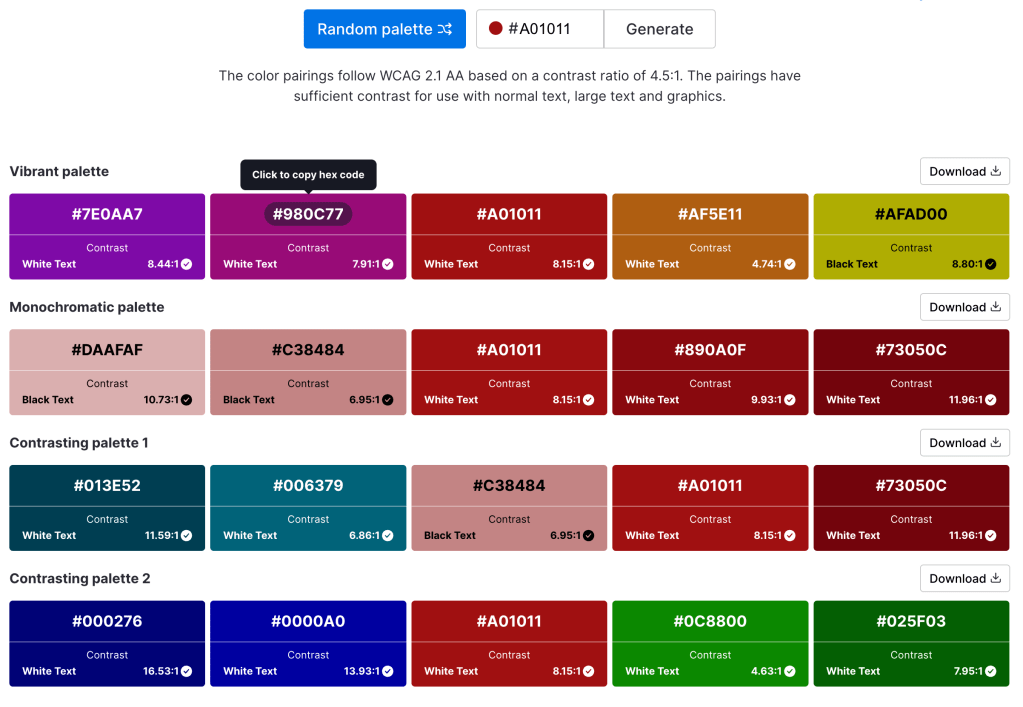
The Venngage Accessible Color Palette Generator is designed to help us make visually appealing color combinations that meet Web Content Accessibility Guidelines (WCAG).
We’ve gone over accessibility many times and we’re doing it again, today! With over 2.2 billion people worldwide having some form of vision impairment, this tool addresses a real need. And, I fear that we’re about to use decades worth of progress on making the “American” web more accessible, as I have no doubt this administration will nuke all the requirements for Government web conte to be accessible. This will also cascade down to the corporate web, since many of them only heed web accessibility guidelines because of the Federal gov internal mandate, which also gets cascaded down to suppliers.
Just either enter a specific HEX code to find accessible palettes based on your preferred color or let your hair downa dnd generate random palettes. This generator shifts the design approach from creating first and checking accessibility later to considering accessibility from the start. This saves time by eliminating extensive revisions. The tool makes this process available to non-designers and those unfamiliar with color theory, letting anyone create WCAG-compliant palettes quickly. This democratization helps ensure more digital content meets accessibility standards.
Wonk time!
As the site notes, contrast — the difference in brightness between elements — is fundamental to accessible design. WCAG 2.1 standards require body text to maintain a contrast ratio of at least 4.5:1 for legibility. Black text on a white background exemplifies high contrast, while yellow text on white creates visibility problems even for those with normal vision. The generator helps meet these requirements without demanding extensive knowledge of color theory.
About 5% of people worldwide have color vision deficiency, with red-green color blindness being most common. An accessible color palette must account for these variations. The tool helps avoid problematic combinations like red and green (which about 5% of people can’t distinguish), red and black (easily confused by those who can’t detect red), and blue and yellow (challenging for those with blue/yellow color blindness). This makes designs inclusive for all users, including the 1 in 12 men and 1 in 200 women with color vision deficiency.
Using accessible color palettes is about inclusion and effective communication. Poor color choices reduce legibility and potentially alienate those with visual impairments or accessibility concerns. The tool bridges this gap by facilitating designs everyone can perceive and understand, regardless of visual capabilities. This approach recognizes that accessibility isn’t a niche concern but fundamental to effective visual communication.
This Drop index query will get you to more WCAG content.
FIN
Remember, you can follow and interact with the full text of The Daily Drop’s free posts on:
- 🐘 Mastodon via
@dailydrop.hrbrmstr.dev@dailydrop.hrbrmstr.dev - 🦋 Bluesky via
https://bsky.app/profile/dailydrop.hrbrmstr.dev.web.brid.gy
☮️

 hrbrmstr's Daily Drop
Leave a comment