quicreach; Believe In Miracles; Rust Katas
Quick note before the hodgepodge resource drops today: Salesforce execs decided to, by default, steal your Slack data to they can train their new “AI” to level up your productivity with “emoji suggestions” o_O. All to check the “AI” box for investors. That link has the instructions to opt-out. You should strongly consider doing so. But — if you really believe that they’ll honor the opt-out — I have a goat farm on Bopak III available for sale.
Also: if anyone did shell out $99 for the Horse browser, I’d be curious to hear your opinion of it. I have no idea how it’s going to succeed without a truly free version available for testing.
(I’m still working on my llamafile TL;DR migration, so TL;DR’s will hopefully return next week.)
quicreach
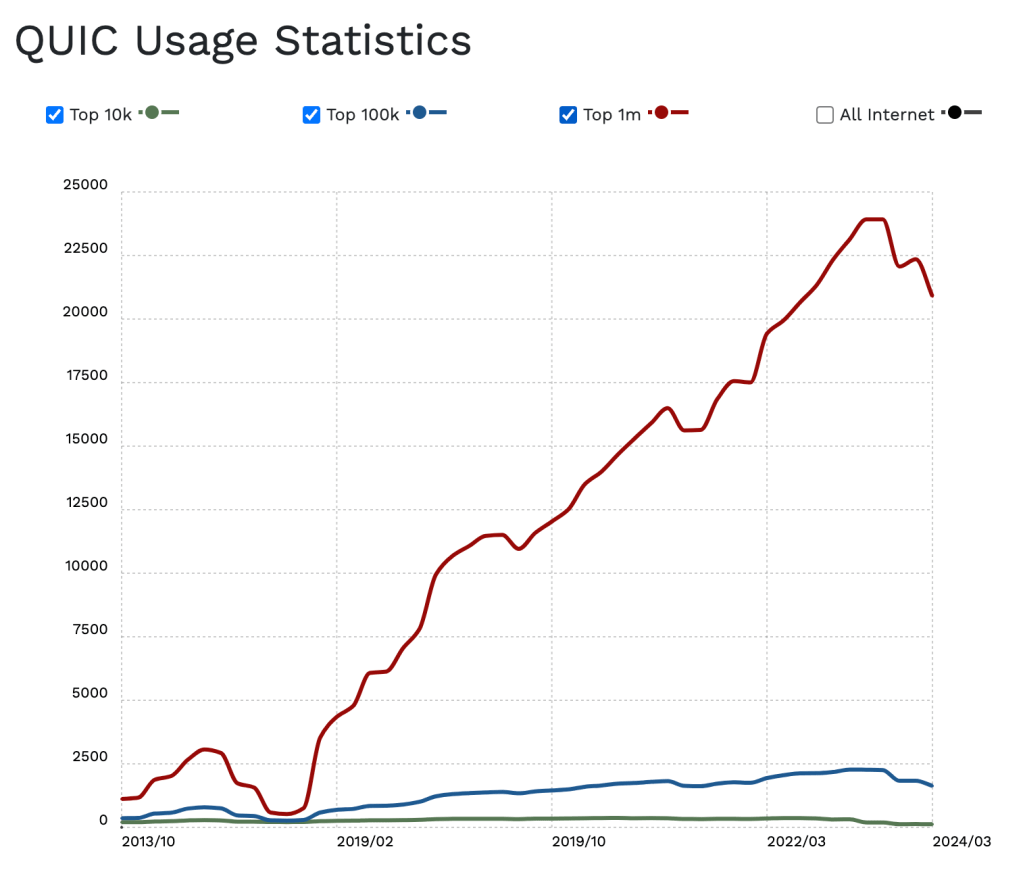
As readers likely know, QUIC (Quick UDP Internet Connections) is a modern transport layer network protocol designed to improve the performance and security of internet communications. Initially developed by Google, QUIC is now being standardized by the Internet Engineering Task Force (IETF) and serves as the foundation for HTTP/3, the latest version of the Hypertext Transfer Protocol.
Some of the benefits include:
- all packets are encrypted and handshake is authenticated with TLS 1.3.
- parallel streams of (reliable and unreliable) application data.
- exchange application data in the first round trip (0-RTT).
- improved congestion control and loss recovery.
- survives a change in the clients IP address or port.
- stateless load balancing.
- easily extendable for new features and extensions.
It has gained some serious adoption, as shown in the section header.
While you can compile curl with support for HTTP/3 to reach out and touch a QUIC-enabled site, Microsoft has released source for a CLI tool — quicreach – that can be used as a sort of “QUIC ping” utility that lets you test the QUIC reachability of one or more target sites.
They’ve baked-in ~5K domains from the Majestic Million, and are running quicreach on them, daily, in a GHA. You can see the results on their dashboard.
I did a test run on a smaller number of domains:
google.commicrosoft.comapple.comx.commastodon.socialbsky.appfacebook.comgithub.combbc.co.ukhuggingface.codata.hrbrmstr.dev
and received the following output:
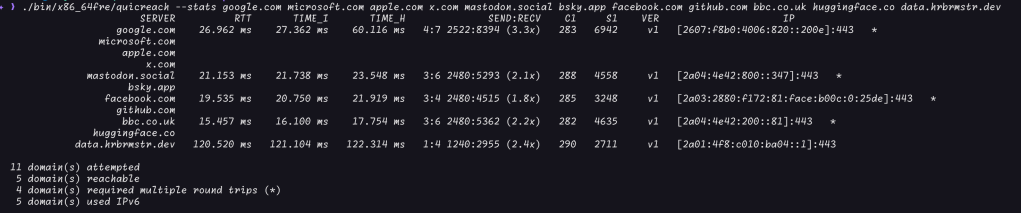
Here’s a, likely, more readable version of that output.
My data.hrbrmstr.dev domain is QUIC-enabled thanks to Caddy‘s built-in support for the h3 ALPN. You will need to do something like this at the top of your Caddyfile if you want to eanble it:
{
  servers :443 {
    protocols h1 h2 h3
  }
}
NOTE 1: The repo uses submodules and took a bit to clone.
NOTE 2: It built on macOS but failed with a bus error when it connected successfuly to a QUIC-enabled server, so the above was tested on arm64 and amd64 linux, as I did not have cycles to triage.
Believe In Miracles

It is a rare thing for tech giants to keep their word, and even rarer when two big rivals promise to do something together, and actually do it.
Apple and Google have launched a new cross-platform feature called “Detecting Unwanted Location Trackers” (DULT) to notify users if a Bluetooth tracking device like AirTag is being used to stealthily track them without consent. This initiative aims to address privacy and safety risks from the misuse of such devices. The feature is available on Android 6.0+ and iOS 17.5, providing alerts and options to locate and disable unwanted trackers. It follows reports of AirTags being abused for stalking and a lawsuit against Apple over the issue.
We all just got a little bit safer thanks to some unexpected collaboration.
Rust Katas
Since we Dropped some Go Katas on y’all last week, it only seems fair to do the same, but using Rust.
This “100 Exercises To Learn Rust“, resource is a bit different as it aims to teach Rust’s core concepts through interactive, hands-on exercises. It covers Rust’s syntax, type system, standard library, and ecosystem. The course is designed to be self-paced, with exercises structured as Rust packages containing instructions, code, and test suites. The wr (workshop runner) tool guides users through the exercises, verifying solutions along the way. By the end, y’all will have solved around 100 exercises, gaining proficiency in small to medium-sized Rust projects.
FIN
Remember, you can follow and interact with the full text of The Daily Drop’s free posts on Mastodon via @dailydrop.hrbrmstr.dev@dailydrop.hrbrmstr.dev ☮️
 hrbrmstr's Daily Drop
Leave a comment