FMLLM; MDN Remodeling; Lucide Icons
I’m back from a $WORK offsite in Austin, TX (the locals I came into contact with were all great, as was most of the food, but y’all can keep the heat and humidity) and pressed the easy button a bit today with two related + lightweight trailing sections about MDN’s remodel and then a fun distraction showing we can all experiment with building small LLMs for fun and potentital unexpected utility.
TL;DR
(This is an LLM/GPT-generated summary of today’s Drop using SmolLM3-3B-8bit via MLX and a custom prompt.)
I normally have to add lines between the entries before rendering the final Drop for use in the WP newsletter format, but today the model not only failed to follow the instruction to not use the word “summary”, it also failed to put the link at the end, and stuck newlines in. Odd.
- FMLLM summary (https://github.com/henrygabriels/FMLLM)
A novelist developed a model using Claude to identify words at Fibonacci intervals in literature, leading to significant improvements in creative writing quality when suggesting words at these intervals. - MDN Remodeling summary (https://developer.mozilla.org/-US/blog/launching-new-front-end/
Mozilla Developer Network (MDN) launched a redesigned front-end with modern CSS and Baseline compatibility, featuring improved typography, code font consistency, and a new search modal for better usability. - Lucide summary (https://lucide.dev/
Lucide is an open-source icon library offering 1,000 scalable vector icons with strict design rules, full framework support, and tree-shaking capabilities, providing customizable and free-to-use icons for web and mobile projects.
FMLLM

A novelist got curious about patterns in great literature and ended up creating something that might actually make “AI”-assisted writing better. The whole thing started because when he was learning to write, he’d make spreadsheets tracking where important words appeared in classic novels. When he plotted these out, they often made spiral shapes, which got him wondering if words that appeared at specific mathematical distances from each other might be connected in meaningful ways.
So he took ~700,000 words of good fiction and had Claude help him build a model that finds which words are most likely to appear at Fibonacci intervals from each other. Instead of looking at words right next to each other like normal language models do, this looks at words that are 1, 1, 2, 3, 5, 8, 13 positions apart and so on.
He tested it by taking basic writing prompts and adding 50 words suggested by his Fibonacci model. When he compared stories written with these word suggestions against regular prompts and prompts with random words thrown in, the Fibonacci versions scored way higher on pretty much everything. Character authenticity went up 23%, voice originality jumped 44%, and overall quality improved 18%.
The weird part is how simple this could be to implement. Any “AI” company could just append suggested words to creative writing prompts without changing their models at all. It’s basically a cheap trick that seems to work.
He also tried making the system complete sentences and add punctuation. Feeding it “sarah loves my french toast”, for example, got back “sarah loves my french toast a piney connubial produit” which is oddly perfect since “piney” evokes maple syrup and “connubial” is a fancy word for romantic love. The punctuation thing was even stranger, correctly placing commas and periods in unpunctuated text with surprising accuracy.
The author/experimenter admits his study was tiny and he’s not a data scientist, but the improvements were big enough that it feels like something worth exploring. His theory is that language might work more like music or architecture, where meaning operates on intervals bigger than just the next word over. If he’s right, it could be a way to make “AI” more creative without the usual computational costs. It also shows how we can all use local, “small” models to accomplish some fun, interesting, and perhaps even useful tools.
He’s keeping some details private since writing is how he makes his living, but he’s open to working with people who have the resources to test this properly at scale.
MDN Remodeling
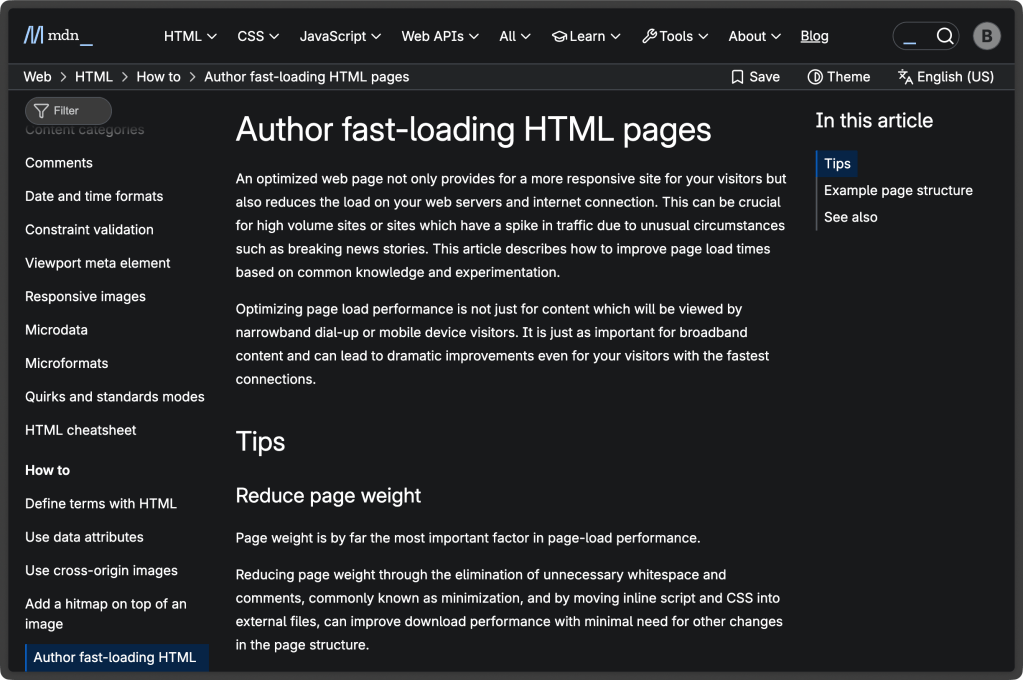
Longtime readers will know one of the only enveavours of Mozilla that I feel deserves any laud is MDN (previously Mozilla Developer Network and formerly Mozilla Developer Center). It’s a documentation repository and learning resource for web devs, born in 2005 as a unified place for documentation about open web standards, Mozilla’s own projects, and developer guides.
MDN recently launched a completely rebuilt front end that was redesigned and reengineered from the ground up. The team spent months working on this major architectural overhaul, which focuses on using modern CSS and web components while targeting Baseline “Widely available” features for broad compatibility. The update includes several UI improvements aimed at better usability and readability rather than dramatic changes (though some element spacing and sizing could use some accessibility work IMO).
They’ve enhanced typography, added a consistent code font for better rendering across platforms, refreshed icons using the Lucide library (more on that in the last section), introduced a new search modal for quick content discovery, and redesigned the top navigation to help folks find content more easily.
The team is committed to continued improvement and welcomes feedback from developers through their Discord channel and GitHub repository, emphasizing that MDN is built by developers for developers. They plan to share more implementation details in an upcoming article about the technical aspects of the rebuild.
Lucide Icons

Lucide (GH) is an open-source icon library that provides over 1,000 scalable vector graphics icons designed for virtually any design medium. It’s a community-driven fork of the popular Feather Icons library, created with the goal of maintaining consistency and readability across all icons through strict design rules. The icons are lightweight, highly optimized, and fully customizable, allowing folks to adjust color, size, stroke width, and other properties to match their our interface needs.
The library has comprehensive framework support, offering official packages for React, Vue, Svelte, Angular, Solid, Preact, React Native, Astro, and static implementations. This makes it straightforward to integrate into virtually any web or mobile project. It further emphasizes “tree-shaking” capabilities, meaning you only import the specific icons you actually use, keeping bundle sizes minimal.
All icons follow a consistent design language and are completely free for both commercial and personal use under the ISC License. There’s also a Figma plugin available for folks who want to use Lucide icons in their design workflows. The library aims to be the solution for anyone who needs a reliable, consistent, and easily customizable icon set that works seamlessly across different technologies and platforms.
FIN
Remember, you can follow and interact with the full text of The Daily Drop’s free posts on:
- 🐘 Mastodon via
@dailydrop.hrbrmstr.dev@dailydrop.hrbrmstr.dev - 🦋 Bluesky via
https://bsky.app/profile/dailydrop.hrbrmstr.dev.web.brid.gy
☮️
 hrbrmstr's Daily Drop
Leave a comment