Epson MX-80; DSEG; IBM Courier
Monospace fonts have been mentioned quite a bit in the feeds, of late, so we have three fun and retro ones for y’all to hack with this week.
TL;DR
(This is an LLM/GPT-generated summary of today’s Drop using SmolLM3-3B-8bit via MLX and a custom prompt.)
We’re back to not following the directions, again.
- Epson MX-80 summary (https://corporate.epson/en/about/history/milestone-products/1980-10-mx80.html): A high-precision impact dot matrix printer with a nine-pin microdot head and bidirectional logic, popular in Japan and the US, capturing 60% of the Japanese market and becoming a standard in the US PC market.
- DSEG summary (https://www.keshikan.net/fonts-e.html): A free font family imitating seven and fourteen-segment display characters, including a weather variant with symbols for weather conditions, featuring colon and space characters of identical width for blinking effects.
- IBM Courier summary (https://github.com/dse/font-og-courier and https://arquivo.pt/wayback/20160517191001/http://www.rolandstroud.com/downloads/essays/courierfonts.pdf): IBM’s digitized Courier font in TTF and other formats, retaining copyright and distribution terms from the IBM/MIT X Consortium Courier Typefont Agreement, with a linked PDF exploring the font’s history and features.
Epson MX-80
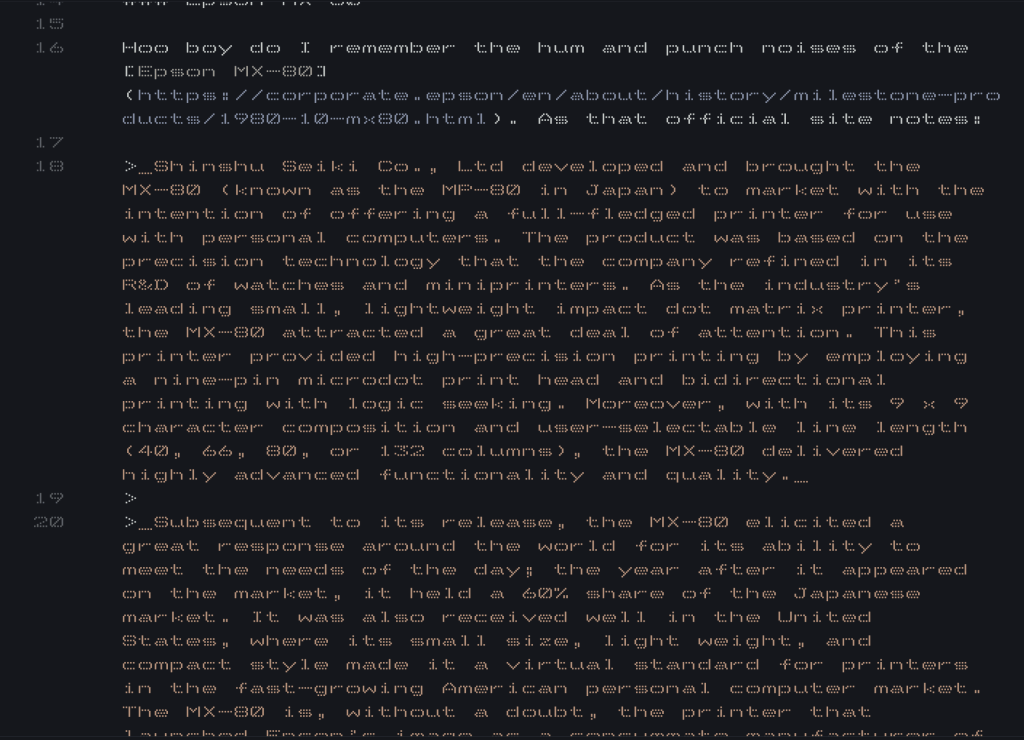
Hoo boy do I remember the hum and punch noises of the Epson MX-80 (you, too, take part in said physical nostalgia).
As that official site notes:
Shinshu Seiki Co., Ltd developed and brought the MX-80 (known as the MP-80 in Japan) to market with the intention of offering a full-fledged printer for use with personal computers. The product was based on the precision technology that the company refined in its R&D of watches and miniprinters. As the industry’s leading small, lightweight impact dot matrix printer, the MX-80 attracted a great deal of attention. This printer provided high-precision printing by employing a nine-pin microdot print head and bidirectional printing with logic seeking. Moreover, with its 9 x 9 character composition and user-selectable line length (40, 66, 80, or 132 columns), the MX-80 delivered highly advanced functionality and quality.
Subsequent to its release, the MX-80 elicited a great response around the world for its ability to meet the needs of the day; the year after it appeared on the market, it held a 60% share of the Japanese market. It was also received well in the United States, where its small size, light weight, and compact style made it a virtual standard for printers in the fast-growing American personal computer market. The MX-80 is, without a doubt, the printer that launched Epson’s image as a consummate manufacturer of printers.
If you are a child of the iPhone/Android era, you will likely never have encountered one of these magnificent beasts. However, that does not mean you cannot experience the output of said beast.
Michael Walden has created digital font recreations of the EPSON MX-80 dot matrix printer fonts from 1980. He manually transcribed the original character bitmaps from the printer’s operation manual in 2009 and has now released them as a comprehensive font pack containing multiple formats for different uses.
The collection includes four main font variations: the standard EPSON MX-80 font, a slashed zero version borrowed from the later FX-80 printer, an enhanced version with improved character centering for fifteen specific characters, and a combination enhanced slashed zero version. He also created 88 additional characters to fill in missing Windows-1252 characters and made various adjustments like repositioning inverted punctuation marks and modifying certain characters for better distinction.
The font pack contains twenty files total across different formats: twelve operating system fonts in .fon, .otf, and .ttf formats, plus eight web fonts in .woff and .woff2 formats. Each format is optimized for specific display sizes that appear crisp on screen, with the bitmap versions working best at sizes like 7, 14, 21, and 29 pixels, while the vector versions work well at 11, 15, 30, and 45 pixels for desktop use, and 10, 20, 30, 40, 50, and 60 pixels for web use.
This was a super fun blast from the past that I can re-experience any time just by switching the active font.
DSEG
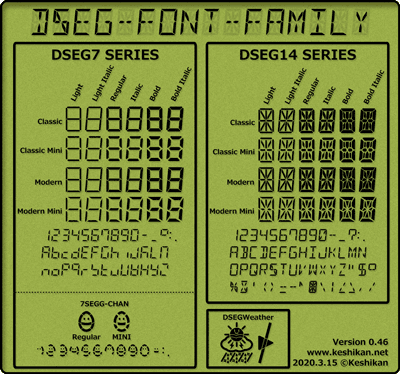
We’re keeping it “retro” in the mid-section with DSEG, a free font family, which imitate seven and fourteen segment display (7SEG, 14SEG). These are the kind you’d see on digital clocks, calculators, and electronic devices. The font comes in said different variants, but also sports “DSEGWeather” which includes special weather symbol characters.
One of its clever features is that the colon and space characters have identical widths, making it easy to create “blinking colon effects” for digital clock displays by simply switching between these characters. The font further supports standard numbers, letters both uppercase and lowercase, and various punctuation marks, though the seven-segment version has more limited character support compared to the fourteen-segment version since real seven-segment displays can’t show all letters clearly.
The aforementioned weather variant includes symbols for different weather conditions like sun, clouds, rain, snow, and thunder using numbers 0-9.
This would pair well with an e-ink display for a nice, “classic weather station” vibe.
IBM Courier

We close out this very mono- and retro-edition with IBM’s digital form of Courier, in TTF and other modern formats, with coding-friendly variants.
As the repo notes, IBM “created a digitized version of Courier and gave the fonts in PostScript Type 1 format to the X Consortium for distribution under the permissive IBM/MIT X Consortium Courier Typefont Agreement. This package retains said copyright and distribution terms.”
Darren includes a link to a doc that I remeber fon[dt]ly, but haven’t shared in a Drop yet: “Everything You Ever Wanted to Know About Courier…And Then Some”. I guarantee you will know more than you have ever wanted to about Courier (and then some).
FIN
Remember, you can follow and interact with the full text of The Daily Drop’s free posts on:
- 🐘 Mastodon via
@dailydrop.hrbrmstr.dev@dailydrop.hrbrmstr.dev - 🦋 Bluesky via
https://bsky.app/profile/dailydrop.hrbrmstr.dev.web.brid.gy
☮️
 hrbrmstr's Daily Drop
Leave a comment