Mind The [Poverty] Gap; Disappeared But Not Forgotten; Don’t Take It For Grant[ed]
I credit the story of Snow’s cholera maps for being the catalyst of my insatiable need to analyze and understand, well, everything. But, he was not the only individual who ended up making a huge difference and (eventual) impact.
We’ve got three sections, today, that are, indeed, intended to inform. But, they have a secondary purpose, to also inspire.
We all can, and need to, make a difference. Now, more than ever.
TL;DR
(This is an LLM/GPT-generated summary of today’s Drop using Ollama + llama 3.2 and a custom prompt.)
- Charles Booth’s 17-year social research project (1886-1903) transformed how we understand urban poverty through groundbreaking data visualization, culminating in the monumental 17-volume “Life and Labour of the People in London.”
- The Trump administration’s immigration enforcement operations have dramatically expanded, with nearly half of recent arrests having no significant criminal convictions or charges, and tactics employed being increasingly aggressive and militaristic, leading to “disappearances” within the detention system.
- A tracker of NIH grant terminations is a crucial tool for transparency and accountability in research funding cuts, providing a centralized, publicly accessible record that supports legal challenges, informs policy discussions, and serves as a valuable resource for the scientific community.
Mind The [Poverty] Gap
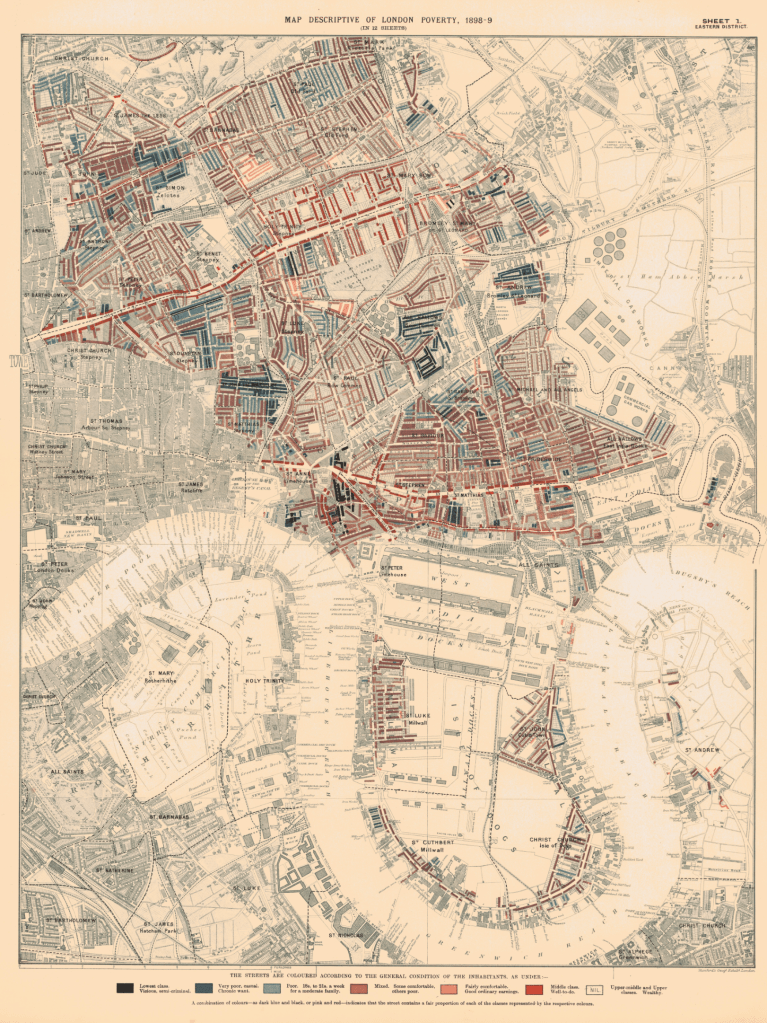
Yesterday marked the 185th birthday of Charles Booth, an individual who fundamentally transformed how we understand urban poverty through groundbreaking data visualization.
Booth was no academic or government official. He was a successful businessman running international leather and shipping enterprises who became disturbed by the poverty he witnessed in London. After the Social Democratic Federation claimed 25% of Londoners lived in extreme poverty in 1885, Booth — skeptical of this figure — decided to investigate himself.
What followed was nothing short of extraordinary.
Without any official commission, Booth personally funded and organized what became a 17-year social research project (1886-1903) culminating in the monumental 17-volume “Life and Labour of the People in London.”
The most visually striking products of Booth’s inquiry were his poverty maps of London, color-coded street by street to indicate levels of wealth and poverty. These weren’t just any maps — they represented the first systematic, data-driven visualization of social conditions in a major city.
Booth’s team conducted immersive fieldwork, interviewing residents and collecting detailed observations. They even accompanied police officers on their beats to gather information for the second series of maps (1898-99).
The maps used a seven-color classification system ranging from “Upper-middle and upper classes. Wealthy” (golden yellow) to “Lowest class. Vicious, semi-criminal” (black). This granular, block-by-block approach revealed patterns of inequality invisible in aggregate statistics.
Booth’s work had immediate practical consequences. His finding that 30.7% of Londoners lived in poverty — higher than previously believed — helped drive policy changes. His advocacy contributed directly to the introduction of Old Age pensions in 1908 and free school meals for the poorest children.
Beyond policy, Booth’s maps transformed social research methodology. His emphasis on empirical data collection, visual representation, and interdisciplinary approach (covering poverty, industry, and “religious influences”) established new standards for social investigation.
What strikes me most about Booth’s story is that he wasn’t waiting for someone else to solve the problem. Seeing inadequate understanding of poverty, he applied his business and analytical acumen to social research — gathering facts, analyzing data, and presenting findings clearly.
Today, we face different but equally complex social (and other) challenges. Booth’s example reminds us that curiosity, determination, and a willingness to invest time and resources can lead to transformative change. You don’t need an official position or academic credentials to make a difference — just the courage to investigate problems thoroughly and the persistence to follow through.
The next time you see a [social] problem that seems overwhelming, remember Charles Booth and ask: what data might illuminate this issue? What visualization could make it impossible to ignore? Sometimes, the most revolutionary act is simply to document reality so clearly that society can no longer look away.
You can see the OG Booth maps and explore a modern, interactive version of them at the London School of Economics and Political Science’s Charles Booth’s Poverty Map and Notebooks.
Disappeared But Not Forgotten
Speaking of a willingness to invest time and resources can lead to transformative change…
Since Trump took office in January 2025, ICE has dramatically expanded its immigration enforcement operations, moving beyond its stated mission of targeting individuals who pose threats to national security and public safety. The agency has arrested over 20,000 people in Trump’s first month alone — a 100% increase from Biden-era numbers.
What’s particularly alarming is the indiscriminate nature of these arrests. While ICE claims to target “significant criminals,” nearly half (45%) of those arrested in recent Massachusetts raids had no significant criminal convictions or charges. ICE has also detained lawful permanent residents, international students, and even U.S. citizens.
The tactics employed are increasingly aggressive and militaristic. Plainclothes agents in masks and hoodies, often without visible identification, have surrounded people in vehicles, raided workplaces, and forcibly taken individuals into unmarked vans. In Chicago, ICE agents have made several warrantless arrests, violating both immigration laws and a 2022 federal settlement agreement.
Most disturbing is the pattern of “disappearances” within the detention system. Hundreds of immigrants have vanished from ICE’s online detainee locator system, leaving families and attorneys unable to locate them for days, weeks, or months. Some detainees have been transported to facilities in other countries without notification to their families or legal counsel.
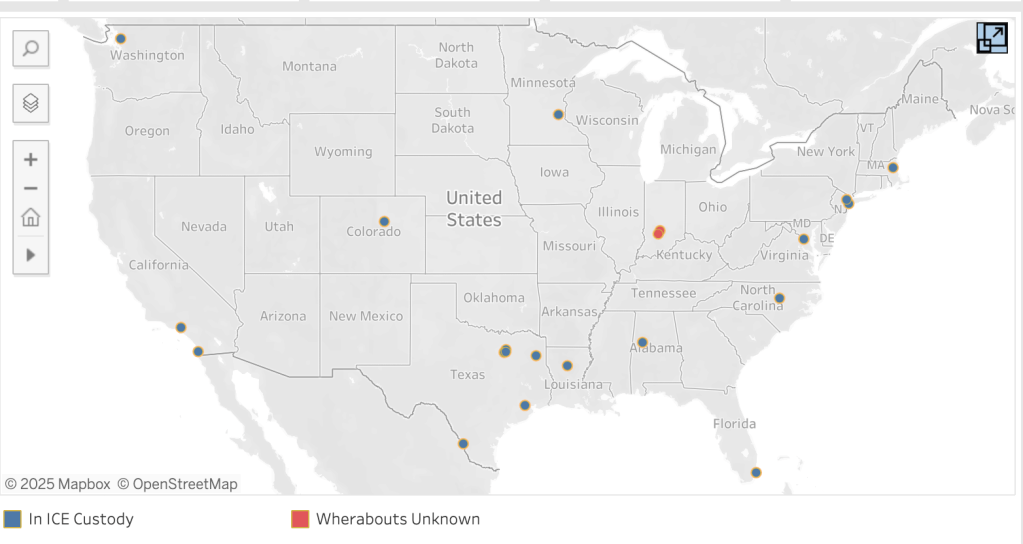
In response to these troubling developments, individuals like (Crip Dyke (@cripdyke.bsky.social) and Danielle Harlow (@danielleharlow.bsky.social) have created resources to track and document these disappearances. The USA Disappeared Tracker and its corresponding interactive map project are monitoring persons politically arrested, detained, or disappeared by the Trump administration since March 9, 2025.
These tracking efforts are crucial for several reasons:
- by documenting each case, they create a record that can be used in legal challenges and advocacy efforts.
- they ensure that those who have disappeared aren’t forgotten or erased from public consciousness.
- the data helps identify systematic abuses rather than treating each case as an isolated incident.
- they provide a resource for families desperately searching for loved ones who have vanished into the detention system.
The United States Disappeared Tracker has documented 245 disappearances so far, visualizing the scope and geographic distribution of this crisis.
These disappearances represent a fundamental violation of due process rights and human dignity. The psychological trauma inflicted on families who don’t know the whereabouts of their loved ones is immense — described by medical experts as a mental anguish that “defies emotional comprehension”.
Moreover, the targeting of lawful residents, activists, and students with valid visas based on their political speech raises serious First Amendment concerns. When ICE arrests students for writing op-eds or participating in protests, it creates a chilling effect that undermines free expression and academic freedom.
The administration’s attempts to remove data from federal websites further obscures these actions from public scrutiny. Without transparency and accountability, the immigration enforcement system becomes a black box where abuses can flourish unchecked.
One person absolutely can make a difference in this crisis. The tracking efforts started by individuals have grown into powerful tools for accountability. By documenting cases, supporting affected families, challenging unlawful arrests, and keeping these issues in the public eye, each of us can help ensure that those who have disappeared are not forgotten and that the system that enables these disappearances is reformed. Your voice, your documentation, your advocacy matters — it may be the lifeline that reconnects a family or prevents another disappearance.
Don’t Take It For Grant[ed]
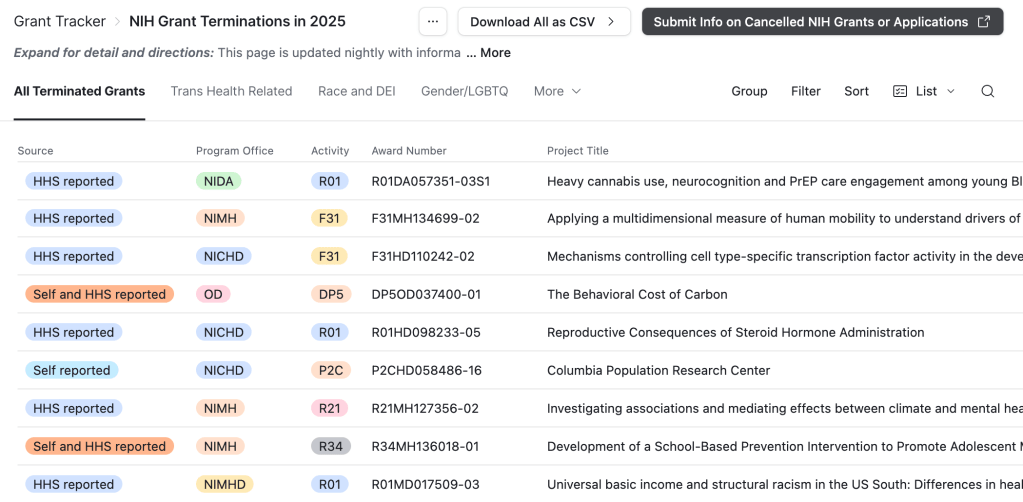
A friend of the Drop and all around IRL superhero clued me into a project they are helping maintain (not mentioning the name/handle since I did not get permission, and am not willing to put anyone in harm’s way) a tracker of NIH grant terminations for use by the community, courts, and correspondents.
The Airtable is updated nightly with information on terminated grants, based on both information published by HHS and self-reported terminations from scientists. It also involves a great deal of scraping, scrounging, and detective work. Every effort is made to ensure accuracy, but there is uncertainty in data shared or published.
Budgeted and remaining funds are drawn from <USAspending.gov> for full grants. For supplements and subprojects, we use HHS-reported values when available, and assume grants of less than 1 year are largely unspent in the absence of data.
This project serves as a crucial tool for transparency and accountability in a time of unprecedented research funding cuts. It provides a centralized, publicly accessible record that supports legal challenges, informs policy discussions, and serves as a valuable resource for the scientific community. By meticulously documenting these terminations, including budgetary details and project information, it creates a historical record and helps quantify the economic and scientific impact on research institutions and public health initiatives. The aggregated data may reveal patterns in targeted research areas, while also raising public awareness through media coverage.
Remember, you don’t have to tackle impactful projects alone. Every contribution, no matter how small, is a step toward positive change. Whether you’re sharing data, offering support, or simply spreading awareness, your efforts matter. In times of challenge, collective action can create powerful ripples of progress. Your involvement, in any capacity, is a noble and necessary part of safeguarding scientific integrity and public health.
FIN
Remember, you can follow and interact with the full text of The Daily Drop’s free posts on:
- 🐘 Mastodon via
@dailydrop.hrbrmstr.dev@dailydrop.hrbrmstr.dev - 🦋 Bluesky via
https://bsky.app/profile/dailydrop.hrbrmstr.dev.web.brid.gy
☮️


 hrbrmstr's Daily Drop
Leave a comment