boat; Roomy; Treeverse
Today’s Hurtsday (Thursday) Drop is another ATproto-focused edition, so if that’s not your cup of tea (I know some Fediverse folks have strong negative opines about anything that isn’t ActivityPub), you’ve been warned.
We’ve got tools to help you manage your blobs, chat with maters, and get a birds-eye view of threads.
TL;DR
(This is an LLM/GPT-generated summary of today’s Drop using Ollama + llama 3.2 and a custom prompt.)
- Boat offers a collection of online tools for working with the AT Protocol, including identity and data management utilities, and retroactive thread gating. (https://boat.kelinci.net/)
- Roomy is a Discord-esque group chat app using ATProto for discovery and Automerge for P2P connectivity, featuring direct messaging and experimental public group spaces. (https://roomy.chat/)
- Treeverse visualizes Bluesky conversation threads as tree structures, allowing users to understand discussions in a spatial format. (https://treeverse.app/)
boat

Boat (GH | CB | knot) is a collection of handy online tools specifically designed for working with the AT Protocol, which powers platforms like Bluesky. Developed by mary-ext, this open-source project provides a suite of utilities that help us interact with and manage various aspects of the AT Protocol ecosystem.
The repository is primarily written in TypeScript and uses the SolidJS framework, making it a modern web application with reactive components without the weight of Vue/React/etc. Boat offers a comprehensive set of tools for both casual use and dev-mode if you fancy working with AT Protocol.
The identity management tools allow you to examine account information by looking up DID (Decentralized Identifier) documents and viewing the operation history of did:plc identities. You can also submit operations to your own did:plc identity, giving you direct control over your decentralized identity.
For data management, Boat provides several archive-related utilities. You can export an entire repository from an account, unpack archives into tarballs for further inspection, and explore repository archives directly in the browser. There’s also a specialized tool for exporting all blobs (binary large objects like images) from an account into a tarball, which is particularly useful for data migration or backup purposes.
The retroactive thread gating tool addresses a specific social need on platforms like Bluesky, allowing users to set reply permissions for all their past posts in bulk. This helps manage conversations and control who can respond to your content across your posting history.
Here’s the full list of finished tools:
- View identity info: Look up an account’s DID document
- View PLC operation logs: Show history of a did:plc identity
- Apply PLC operations: Submit operations to your did:plc identity
- Export repository: Download an archive of an account’s repository
- Unpack archive: Extract a repository archive into a tarball
- Explore archive: Explore a repository archive
- Export blobs: Download all blobs from an account into a tarball
- Retroactive thread gating: Set reply permissions for all of your past Bluesky posts
- Generate secret keys: Create a new secp256k1/nistp256 keypair
Mary is somewhat of a legend in the skyverse and has many other spiffy projects we have and will touch on in the Drop.
Roomy
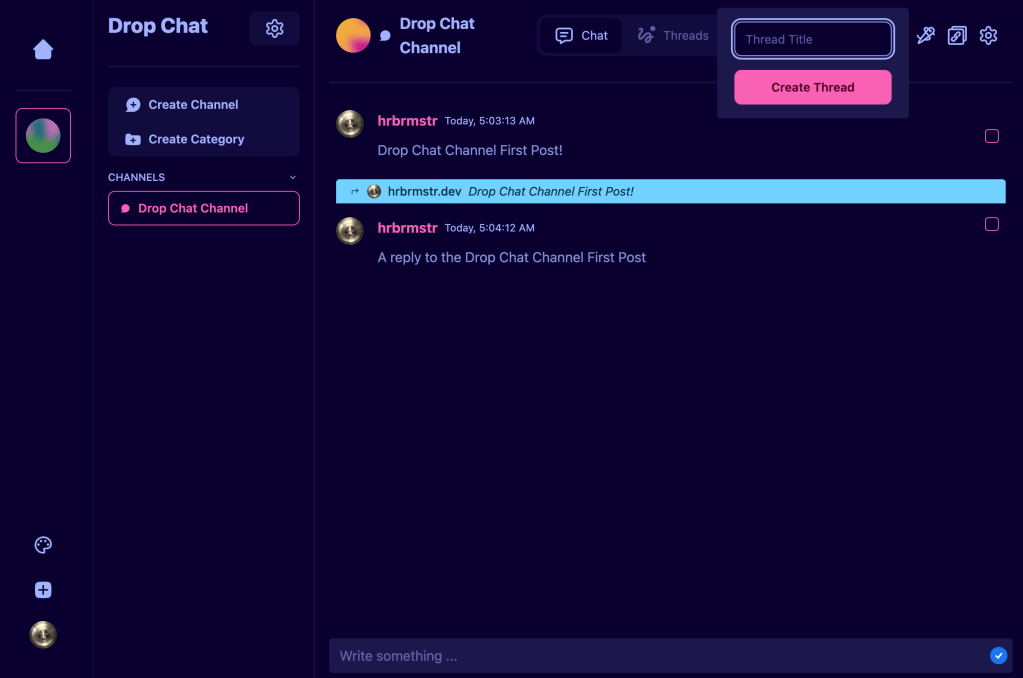
Roomy (GH) is a Discord-esque group chat app that leverages ATProto for social discovery and Automerge for peer-to-peer connectivity. The project received funding from Skyseed to develop a chat prototype on the AT Protocol, with development led by a small team including developers from zeu.dev and direction from erlend.sh.
Currently in (very) alpha stage, Roomy offers direct messaging functionality that backs up to Personal Data Stores (PDS). The application allows BlueSky account holders to create direct messages and chat with other folks who have also initiated a direct message connection. The team has recently expanded functionality to include public group spaces with channels and categories, though this remains highly experimental.
Roomy’s architecture differs significantly from typical ATProto applications. While most ATProto apps rely on a relay to aggregate data from PDSes and send it to AppViews, Roomy operates in a more peer-to-peer fashion. This approach reduces dependency on centralized components and potentially lowers operational costs. The system uses Conflict-Free Replicated Data Types (CRDTs) through the Automerge library, swhich makes it possible to chat while offline and synchronize later without conflicts.
For data storage, Roomy saves Automerge document snapshots to your home PDS and the PDSes of other chatterlings. When users make changes to a chat, these are captured in snapshots saved both to browser storage and to their PDS. The system handles synchronization between acounts by loading and merging snapshots from multiple PDSes. Since PDSes don’t support private data storage, Roomy implements encryption for direct messages, though the developers acknowledge this isn’t a perfect solution. (Use Signal for end-to-end encryption, and try to avoid accidentally inviting journalists into your chats).
The infrastructure includes several microservices: a Key Server that generates keypairs for each account, a Routing Server that connects clients for instant messaging, a Space Coordinator that tracks which PDSes have the latest data for group spaces, and a Handle Resolver for translating user handles to ATProto DIDs. The frontend is a static web application that can be hosted almost anywhere.
The Roomy team plans to implement group chats with improved UI features like replies and reactions. They’re also exploring ways to make Roomy more decentralized, such as allowing folks to manage their own keys and potentially run their own routing and coordination services. The developers envision Roomy growing beyond chat to incorporate forum features, wiki pages, and digital gardening tools.
Despite being experimental, Roomy represents an neat exploration of how peer-to-peer architectures can be combined with ATProto to create applications that are less dependent on centralized infrastructure while still providing familiar social networking functionality.
For more technical details this blog and this are “must reads”. And, you can hit up the, I guess “room”?, in the section header at this URL.
Treeverse
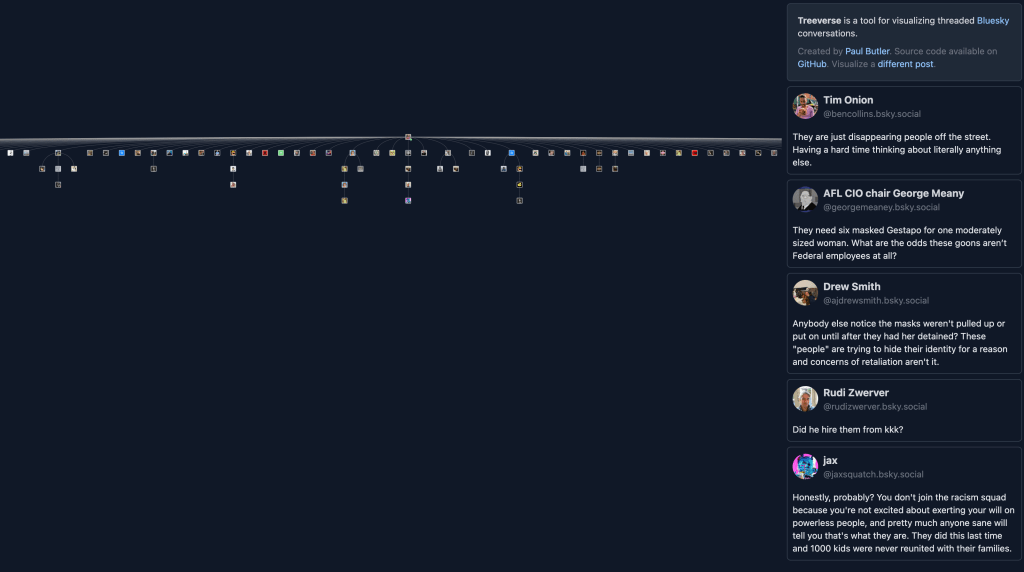
Treeverse (GH) is a web app designed to visualize conversation threads on Bluesky as tree structures, offering a spatial representation of discussions that might otherwise be difficult to follow in traditional linear formats. Developed by Paul Butler, this tool evolved from its previous incarnation that served Twitter users from 2014 to 2023, before API changes rendered that version obsolete.
Using Treeverse is straightforward — just paste a Bluesky post URL or an at:// URL to generate a tree visualization of the conversation.
The section header is this tree of this thread.
FIN
Remember, you can follow and interact with the full text of The Daily Drop’s free posts on:
- 🐘 Mastodon via
@dailydrop.hrbrmstr.dev@dailydrop.hrbrmstr.dev - 🦋 Bluesky via
https://bsky.app/profile/dailydrop.hrbrmstr.dev.web.brid.gy
Also, refer to:
to see how to access a regularly updated database of all the Drops with extracted links, and full-text search capability. ☮️
 hrbrmstr's Daily Drop
Leave a comment