Content Authenticity Initiative; URLQuery; The Authentic Personality
Today’s Friday Drop takes a slight turn from tech tools to three different takes on different types of authenticy.
TL;DR
(This is an AI-generated summary of today’s Drop using Ollama + llama 3.2 and a custom prompt.)
- The Content Authenticity Initiative (CAI) is a collaborative effort that establishes industry standards for digital content provenance through sophisticated metadata tracking and verification systems (https://contentauthenticity.org/)
- URLQuery provides comprehensive URL security assessment through multiple threat detection mechanisms including YARA-based detection, reputation analysis, and content inspection (https://urlquery.net/)
- The Authentic Personality Scale measures individual authenticity through three components: self-alienation, authentic living, and accepting external influence, with research showing strong connections between authenticity and psychological well-being (https://www.researchgate.net/publication/42739517_The_Authentic_Personality_A_Theoretical_and_Empirical_Conceptualization_and_the_Development_of_the_Authenticity_Scale)
Content Authenticity Initiative

The Content Authenticity Initiative (CAI) is a collaborative effort founded in 2019 by Adobe, The New York Times, and Twitter (now, X) to establish industry standards for digital content provenance and authenticity. It was formed with the hopes of addressing the very real challenges of digital misinformation and content verification.
The CAI works with the Coalition for Content Provenance and Authenticity (C2PA) — established in 2021. C2PA membership includes well-known names such as the BBC, Microsoft, Intel, and others. The system employs sophisticated metadata tracking that captures key information about digital content, including:
- Publisher information
- Recording device details
- Location and timestamp data
- Content modification history
This metadata is secured through hashcodes and certified digital signatures, ensuring that both the content and its associated provenance information remain tamper-evident.
The initiative provides open-source tools that let us integrate provenance signals into what we build or publish. A key feature is the ability to track and verify:
- Content modifications over time
- Identity information
- AI involvement in content generation or modification
- Edit history and types of changes made
The CAI’s approach doesn’t attempt to determine absolute truth but rather establishes reliable content origin verification. This system maintains integrity even when content is shared across platforms — i.e., files with C2PA-compliant metadata retain their provenance information when shared on social media or other platforms.
The initiative has grown significantly, with over 200 members as of 2022, including major technology companies, media organizations, and academic institutions. Through free membership, organizations can access prototype support, industry events, and connect with a global community working toward digital content transparency.
One member’s — Starling Lab — work with image authentication adds a interesting technical and ethical dimension to the CAI story, that sheds some light on both the promise and complexity of digital content verification.
With the processes and technologies Starling has developed with equipment manufacturers and publishing outlets, the journey of, say, a photograph now follows three critical stages that establish its authenticity. At capture, new camera technology creates a secure fingerprint of the image’s contents, including time and location data. During storage, decentralized web networks maintain multiple sealed copies to prevent tampering. Finally, the verification stage transparently records all editorial changes and fact-checking processes
The system transforms each photograph into a kind of self-contained repository of trust, carrying its own history and provenance information through the JPEG universal metadata box format. However, this technical capability comes with important ethical considerations. While it aims to combat disinformation, it must be implemented as a choice rather than an obligation to prevent misuse as a surveillance tool. The system’s strength lies in its decentralized nature, allowing trust to emerge from a diversity of voices rather than a single authority.
None of this replaces human judgment. At best, it enhances it, and provides tools for transparency while acknowledging that authenticity isn’t solely a technical problem.
Some practical examples of this effort are “The News Provenance Project”, Adobes purported commitment to both transparency and “Do Not Train” in their Firefly AI system.
You can even use standard CLI tools to inspect a JPEG to see if it has provenance information.
Go to this URL — https://rud.is/ex/201e328a-8199-4392-9dc5-e33c43325ac6.jpeg — to download the JPEG version of this image (WordPress mangles uploads):

to your filesystem and do:
$ exiftool -jumbf:all -G3 -b -j -u -struct 201e328a-8199-4392-9dc5-e33c43325ac6.jpeg
to see a massive bit of JSON info about its lineage (you can see the JSON @ https://rud.is/ex/provenance.json). I had to use an image, below, given how cruddy my current WordPress options are for inline JSON formatting:

Unfortunately, I don’t see many news outlets or social media sites adopting this, yet; and, I’m not sure I want this tech baked into our phone cameras since that will likely just end up only giving credibility to the incredulous.
But, if you do see those little “(i)” info dots and boxes, perhaps download the image and use exiftool to double-check the veracity of the provenance.
URLQuery
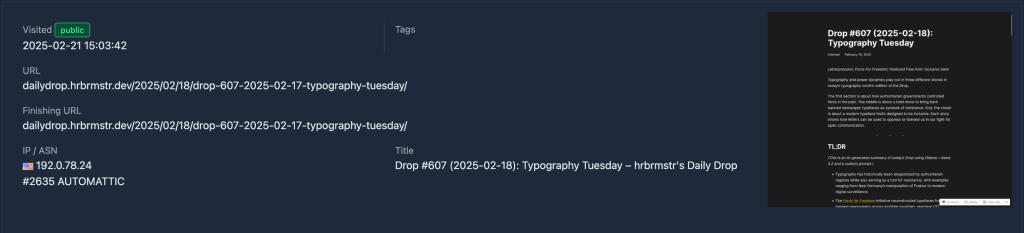
Images are the only bits that require verification! URLs can be one of the most deadly types of strings flying through the internets, and being SUPER SURE they’re safe is always a plus.
URLQuery is a spiffy URL analysis platform that combines multiple threat detection systems to provide comprehensive security assessment of web addresses. The platform employs a multi-layered approach to security analysis, integrating several key detection mechanisms:
YARA-Based Detection
This system acts as a versatile security tool, examining URLs for specific patterns and characteristics associated with known malicious activities. While highly effective for identified threats, it may have limitations with polymorphic malware.
Reputation Analysis
The platform evaluates URLs based on their historical behavior and known activities. This method effectively identifies established threats but may miss newly compromised legitimate websites.
Network-Based Detection
The NIDS component monitors network traffic patterns, functioning as a digital sentinel to identify suspicious activities and potential security breaches. It excels at detecting anomalous network behavior but faces challenges with encrypted traffic.
Content Analysis
This component performs deep inspection of webpage content, examining scripts and code elements to uncover hidden malware or malicious code. While thorough, this method requires significant resources and may be challenged by sophisticated obfuscation techniques.
With an API key, you can use it programmatically, and a handy Golang service exists — uqw — that makes integrating it into safety workflows super easy. You can use the accompanying Golang REST API module — https://github.com/urlquery/urlquery-api-go — as well, if you want to roll your own.
Here’s the report for this week’s Tidy Tuesday Drop — https://urlquery.net/report/a48e56e6-0dc7-439c-ad12-49eb0578da52 — so you can see what you get.
The Authentic Personality
“Being authentic” has been all the rage in influencer land the past 5-or-so years despite most of said influencers feeling woefully unauthentic. But what is “authentic” and how do we know if we are really being “authentic”? Back in 2008, a group of researchers developed a scale — The Authentic Personality: A Theoretical and Empirical Conceptualization and the Development of the Authenticity Scale — to assess how authentic folks are in our daily lives, based on three key components.
First, there’s self-alienation — that disconnect between who we truly are and our conscious awareness of ourselves. Think of it as that nagging feeling of being “out of touch” with your true self.
Then we have authentic living — essentially walking the walk, not just talking the talk. This measures how much people’s actions align with their deeply held values and beliefs.
Finally, there’s accepting external influence — how much we let others’ opinions and expectations shape our behavior and decisions.
What (IMO) makes this research worth sharing is how thoroughly they validated their scale. They tested it across different groups — different ethnicities, genders, ages — and found it worked consistently well. The scale also proved to be quite stable over time, suggesting it’s measuring something fundamental about personality rather than just temporary states.
Perhaps most intriguingly, they found strong connections between authenticity and well-being. People who scored higher on authenticity tended to be happier, more satisfied with life, and showed better psychological functioning overall. In fact, authenticity turned out to be one of the strongest predictors of well-being they’d seen in personality research. (If you lie to yourself daily, that does take a toll.)
This work opens up fascinating possibilities for understanding how authenticity develops over time, how it might be affected by trauma or therapy, and how it might differ across various social groups. It’s given us a reliable tool to explore these questions scientifically while validating what many philosophers and psychologists have long believed — that being true to oneself is fundamental to psychological health and well-being.
If you do not feel like reading a 17-year-old academic paper but are still curious (some folks will likely dismiss the entire concept outright, which is legit fine), you can use the following to self-assess:
Rate each of these statements on a scale from 1 (does not describe you at all) to 7 (describes you very well):
- “I think it is better to be yourself, than to be popular”
- “I don’t know how I really feel inside”
- “I am strongly influenced by the opinions of others”
- “I usually do what other people tell me to do”
- “I always feel I need to do what others expect me to do”
- “Other people influence me greatly”
- “I feel as if I don’t know myself very well”
- “I always stand by what I believe in”
- “I am true to myself in most situations”
- “I feel out of touch with the ‘real me’”
- “I live in accordance with my values and beliefs”
- “I feel alienated from myself”
To score your results:
Authentic Living Score: Add up items 1, 8, 9, and 11
- Higher scores indicate more authentic living
Accepting External Influence Score: Add up items 3, 4, 5, and 6
- Higher scores indicate more external influence (less authenticity)
Self-Alienation Score: Add up items 2, 7, 10, and 12
- Higher scores indicate more self-alienation (less authenticity)
When taking the assessment, it’s important to focus on a specific context in your life (like work or relationships) since authenticity can vary across different situations.
FIN
Remember, you can follow and interact with the full text of The Daily Drop’s free posts on:
- 🐘 Mastodon via
@dailydrop.hrbrmstr.dev@dailydrop.hrbrmstr.dev - 🦋 Bluesky via
https://bsky.app/profile/dailydrop.hrbrmstr.dev.web.brid.gy
Also, refer to:
to see how to access a regularly updated database of all the Drops with extracted links, and full-text search capability. ☮️
 hrbrmstr's Daily Drop

Leave a comment