A DNS by Any Other Name Would Still Let You Login; Tarjetas Rojas; Sprinter
The aforementioned 47-watch now generates JSON, CSV, and Parquet data files and each document includes the markdown text of the order.
This new project has made it a tad difficult to coalesce themes this week, so we’ve got a grab bag, again
Please strongly consider using the one in the middle section. We need all the helpers we can muster.
TL;DR
(This is an AI-generated summary of today’s Drop using Ollama + llama 3.2 and a custom prompt.)
- DNS handles proposed as universal identifiers for cross-platform authentication, building on existing infrastructure like OAuth and OpenID to enable single sign-on capabilities (https://mailarchive.ietf.org/arch/msg/oauth/t7T4U4Ly4FW75pwkZk7jgaCwuAE/)
- Red Cards (Tarjetas Rojas) serve as crucial legal tools helping individuals assert constitutional rights during immigration encounters, available through ILRC in multiple languages and formats (https://www.ilrc.org/red-cards-tarjetas-rojas)
- Sprinter offers a browser-based distraction-free writing environment that integrates with Postbox for document syncing, designed by Astrohaus to introduce users to focused writing (https://sprinter.getfreewrite.com/)
A DNS by Any Other Name Would Still Let You Login

Phillip Hallam-Baker has proposed a novel authentication system that would use DNS handles (like @user.domain.com) as universal identifiers across digital services. Similar to how email addresses serve as unique identifiers, these DNS handles would allow folks to authenticate across multiple platforms using a single identity, much like how Bluesky currently implements its authentication system.
The proposal posits a future where we could maintain our digital identities independently of any specific service provider. For example, Phillip could register phill.hallambaker.com and use @phill.hallambaker.com to log into various services, or alternatively use a service-provided handle like @user.bsky.social. This approach would fundamentally change how single sign-on works by making the authorization service a primary component rather than an add-on to content providers.
One of the system’s most practical benefits would be the ability to perform just one morning login to access multiple services throughout the day, potentially eliminating the need for passwords entirely. The system could extend beyond just authentication to include Internet of Things (IoT) devices, enabling automated DNS record creation and certificate management for connected devices.
However, the proposal faces two significant challenges. First, using the same identifier across multiple services could make it easier to track our activities across platforms, raising privacy concerns. Second, the system would need robust mechanisms for identity recovery and control, particularly for folks who might not be technically savvy enough to manage their own DNS records.
From a technical perspective, the proposal builds on existing infrastructure, including OAuth, OpenID, DNS Update, and ACME protocols. This approach would require primarily integration and standardization work rather than developing entirely new protocols. However, there is ongoing debate in the technical community about whether current OAuth standards already provide adequate support for this functionality.
The OAUTH-WG IETF thread is worth a few minutes to read over. It’s a civil discussion that I do think warrants serious consideration.
Tarjetas Rojas

Red Cards (Tarjetas Rojas) are essential legal tools created by the Immigrant Legal Resource Center to help individuals protect their constitutional rights during encounters with immigration authorities. These wallet-sized cards serve as a crucial bridge between immigrants and law enforcement, particularly during sensitive situations like ICE home visits. They enable clear communication of rights regardless of immigration status or language barriers.
The cards are widely accessible through multiple channels. Nonprofit organizations and public defenders can obtain them at no cost directly from ILRC (NOTE that this policy has been temporarily paused due to high demand). For those interested in creating their own, ILRC provides print-ready artwork formatted for standard business cards (3.5″ x 2″). Organizations (or just folks) needing larger quantities can order through a union printing service, with bulk orders starting at 1,000 cards.
To ensure effectiveness and longevity, the cards are designed to withstand regular use. While they can be printed personally, professional printing with protective coating is strongly recommended. The cards’ multilingual versions are particularly valuable for monolingual immigrants, ensuring they can effectively communicate their rights to immigration officers without language barriers. This accessibility across languages helps ensure constitutional protections are available to all, regardless of English proficiency.
The standardized business card format makes them convenient to carry while being durable enough for frequent reference. When professionally printed with rounded corners and protective coating, they can withstand the wear and tear of daily carry in wallets or pockets, ensuring they’re available when needed most.
I realize not everyone is well-resourced, but laminators are fairly inexpensive (if you print your own).
ICE has a 100-mile inland-from-border reach, and many law enforcement agencies — including the one in Sanford, Maine — are making calls for residents to “see something? say something.”.
Sprinter
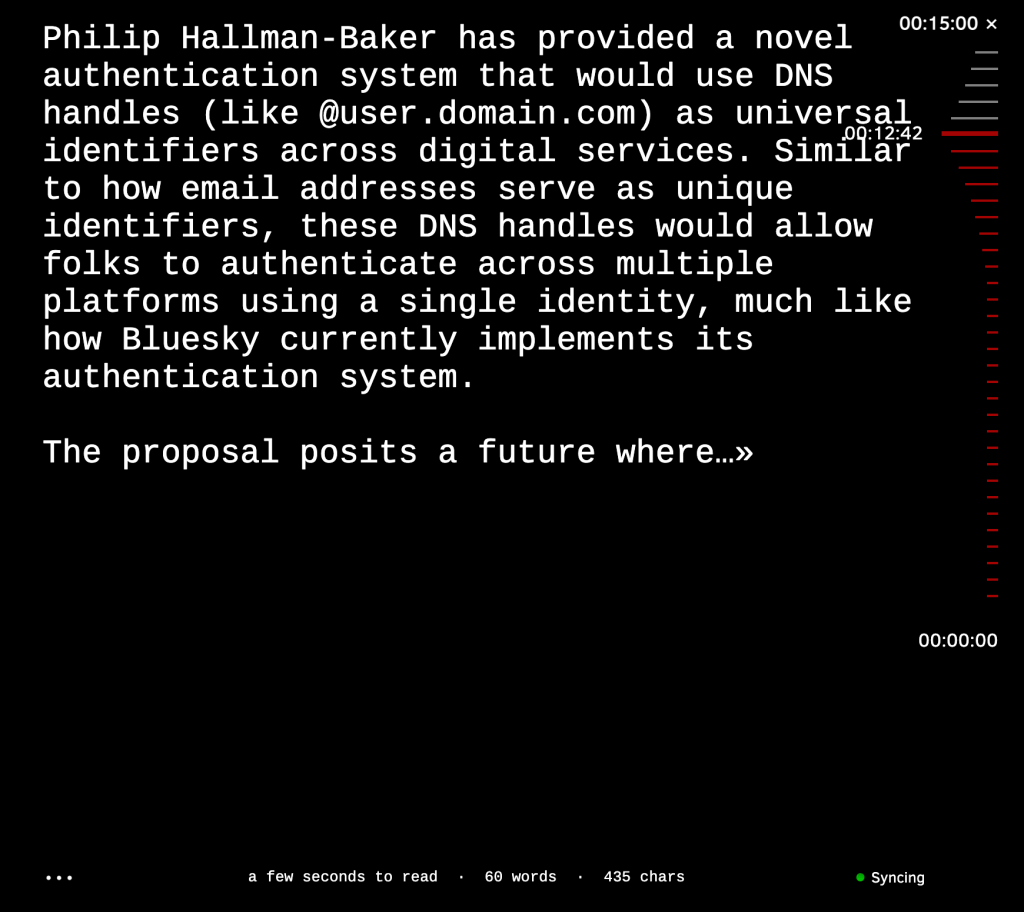
I’m not sure we really need to put our content into yet-another cloud service, but I respect the goals and operations of Astrohaus, adore their Freewrite kit, and also am impressed with the minimal-yet-super-functional design of Sprinter.
Their words were just fine, so here’s what it is/what it does:
Sprinter is a distraction-free writing tool found directly in your browser. Best of all, it integrates directly with Postbox so documents are synced and saved there automatically. Right now, all Sprinter drafts go to Folder A.
The idea behind creating Sprinter is to introduce people to the concept of ‘distraction-free’ writing with as low a barrier as possible. While we can’t convey all of the awesomeness of using the Freewrite with a browser-based app, we tried to transfer as much design thinking we could into Sprinter. Since there is no way to have a true distraction-free experience in a browser, we implemented writing goals directly into the interface. By default, you start with a 15-minute goal which is meant to get quickly started and stay engaged despite being surrounded by the Internet.
It is very much aimed at writers (so much so that you cannot paste text into Sprinter).

You can sync documents to multiple services, and retrieve them in various formats.
Freewrite owners are more likely to use Sprinter and Postbox, but if you’re looking to mix things up, this may be a new place for your textual creative endeavors.
FIN
Remember, you can follow and interact with the full text of The Daily Drop’s free posts on:
- 🐘 Mastodon via
@dailydrop.hrbrmstr.dev@dailydrop.hrbrmstr.dev - 🦋 Bluesky via
https://bsky.app/profile/dailydrop.hrbrmstr.dev.web.brid.gy
Also, refer to:
to see how to access a regularly updated database of all the Drops with extracted links, and full-text search capability. ☮️
 hrbrmstr's Daily Drop
Leave a comment