License To Design; BADASS LIBRE FONTS BY WOMXN; Featured (Free) Font: Ortica
Today’s typography-centric edition of the Drop pulls out the legal pad to scribble some prose about the intricate world of font licensing. It also celebrates womxn designers in typography, and showcases an elegant font family from a featured collection.
TL;DR
(This is an AI-generated summary of today’s Drop using Ollama + llama 3.2 and a custom prompt.)
- Font licensing encompasses various types (Desktop, Webfont, App, etc.) that govern usage rights and protect designers’ intellectual property (https://dailydrop.hrbrmstr.dev/2023/09/19/drop-336-2023-09-19-typ-arrrr-graphy-tuesday/)
- BADASS LIBRE FONTS BY WOMXN showcases free, open-source fonts created by womxn designers to highlight their contributions to typography (https://www.design-research.be/by-womxn/)
- Ortica is a calligraphic serif font family featuring bold and light variants, inspired by Vojtech Preissig’s work and available through Collletttivo (https://www.collletttivo.it/typefaces/ortica)
License To Design

I’m going to be featuring many more fonts — both paid and free — in these Tuesday editions of the Drop in 2025. While we’ve covered some aspects of font licensing, I wanted to start the year with a slightly more comprehensive view of the topic than we have, previously.
Understanding font licensing is more important than you might realize. They govern how fonts can be used, shared, and distributed, and are very real legal agreements that specify the permissions and restrictions associated with a particular font. These terms are outlined in the End User License Agreement (EULA), which varies between different type foundries. Adhering to these licenses ensures legal compliance, supports type designers, and promotes a healthy type industry.
Reading, understanding, and adhering to a given license is — above all else — a sign of respect for the intellectual property rights of type designers. We’ve covered the font creation process many times, and our ethical use of fonts acknowledges the years of effort and creativity involved in crafting a typeface. By obtaining (which may involve purchasing) the appropriate license, we provide fair compensation to designers, enabling them to continue producing high-quality fonts. Additionally, proper licensing offers legal protection, reducing the risk of fines or lawsuits (which happen quite a bit, but are usually settled out of court) associated with unauthorized font use. Licensed users also benefit from updates (fonts are software!), support, and quality assurance from the font creator, ensuring design consistency and functionality.
There are several common types of font licenses, each tailored to specific uses:
- Trial licenses are free licenses which let us test fonts and even use them in creations we want to showcase before actually making a purchase. Trial licenses typically prohibit use in commercial end products and may be time-limited or feature a reduced glyph set. For example, TypeTogether offers a trial license that includes all glyphs and is available for one month, but it does not permit the creation, sale, distribution, or client delivery of end products without completing a font purchase.
- a Desktop license permits the installation of fonts on a specified number of workstations for use in software like editors, terminals, and design applications. This license does not cover web usage or app embedding, and fonts cannot be shared or redistributed unless explicitly allowed in the license.
- Webfont licenses allow fonts to be embedded into a website using technologies like the standard CSS
@font-face. They’re often based on metrics such as the number of page views per month. The fonts are stored on a web server, enabling browsers to render the website as intended. - if you make installable apps, an App License permits fonts to be embedded within a mobile or desktop application, and may be based on the number of app installations or platforms supported.
- Ebook licenses let us embedded fonts in electronic publications, such as ebooks or PDFs, ensuring consistent typography across digital reading devices.
- believe it or not there’s a special Broadcast license which covers usage in TV, streaming services, and video productions (including ones that end up on YouTube, et al.). Pricing for these ones usually varies based on audience size, broadcast duration, and geographic reach.
- Value-based licenses moves away from flat-fee structures and scale prices based on organization size and usage scope. This model enables smaller businesses (or just you and me) to access quality fonts at more affordable rates while ensuring larger enterprises contribute proportionally.
- you can also acquire Rental/Subscription licenses which provide temporary access through hosted solutions (like Adobe Fonts); these offer more flexibility for short-term projects without requiring permanent licenses.
- Finally (for this list, anyway) Open Source Licensing — which is, now, mostly the SIL Open Font License (OFL) — lets us freel use and modify fontws with very minimal restrictions. While beneficial for limited budgets, these fonts often have limitations in character sets and language support.
Now, IANAL, so you have to double-check on your own if your use of a given font I will be showcasing is on the up-and-up.
You may be surprised to learn that there are services similar to YouTube’s use of Content ID which scan for font license violations.
Letterhead Fonts has a FontGuard system that uses a proprietary encryption system created that embeds purchaser account info into each of the font files. This lets them trace the files back to the original purchaser (and you may be held liable if you aren’t the purchaser but use the font).
Font Radar has a service any foundry can use to enforce licensing. Their counter:
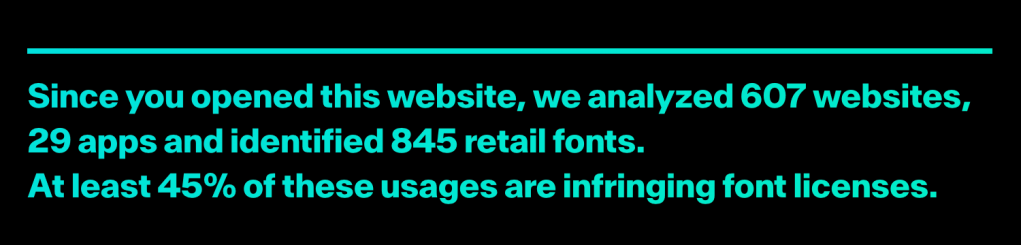
is cute, and that scan data is likely somewhat accurate, too.
I will be making sure to include the license type with each shared font
BADASS LIBRE FONTS BY WOMXN

(I’m not shouting, they are!)
BADASS LIBRE FONTS BY WOMXN (GL) is a font collection dating back 2018 with a mission to highlight the contributions of womxn designers to the traditionally conservative field of typography.
The fonts featured are freely available under the Free, Libre, and Open Source (FLOSS) licenses, enabling unrestricted usage, modification, contribution of additional glyphs or styles to their non-nuclear families, and further development and redistribution.
Generously published at no cost, these fonts foster an ecosystem of sharing and collaboration.
To support the designers, consider allocating funds within your project’s design budget for direct donations, commissioning custom font designs, inviting them to deliver lectures, or promoting their exceptional work.
The last section highlights one free font from the collection.
Featured (Free) Font: Ortica

Ortica is a calligraphic serif with two families, each with their own charm. Ortica Bold takes inspiration from the work of Czech designer Vojtech Preissig: like his Preissig Antiqua, Ortica is constrained by the use of only straight segments. Ortica Light is a tad curvier but also has spiky serifs. Used big, Ortica fully shows its construction and character; in smaller sizes it still keeps its elegance and functionality.
FIN
Remember, you can follow and interact with the full text of The Daily Drop’s free posts on:
- 🐘 Mastodon via
@dailydrop.hrbrmstr.dev@dailydrop.hrbrmstr.dev - 🦋 Bluesky via
https://bsky.app/profile/dailydrop.hrbrmstr.dev.web.brid.gy
Also, refer to:
to see how to access a regularly updated database of all the Drops with extracted links, and full-text search capability. ☮️
 hrbrmstr's Daily Drop
Leave a comment