TODS; Raiding The Archive; Unicode 16
We have, in reverse order, something old, something borrowed, and something new in today’s typography-centric edition of the drop!
TL;DR
(This is an AI-generated summary of today’s Drop using Ollama + llama 3.1b and a custom prompt.)
- TODS (Typography and OpenType Default Stylesheet) establishes typographic defaults for web projects, leveraging OpenType font features (https://clagnut.com/blog/2433)
- The Internet Archive’s Open Source Software Collection offers a treasure trove of font collections from vintage CD-ROMs (https://archive.org/details/open_source_software?tab=collection&query=font+collection)
- Unicode 16.0 adds 5,185 new characters, including seven new scripts and eight new emoji (https://blog.unicode.org/2024/09/announcing-unicode-standard-version-160.html)
TODS

TODS — the Typography and OpenType Default Stylesheet project (GH) — sets out to establish sensible typographic defaults for prose text, making the most of OpenType font features. It’s intended as a starting point for web projects, honing in on typography rather than layout or specific design elements.
TODS comes packed with a modern CSS reset tailored for typography and supports web font loading, including variable fonts. It sets global defaults for things like line height, ligatures, and kerning. The stylesheet offers block spacing utilities, utility classes for OpenType features, and helper classes for common typographic tasks. It also provides defaults for styling prose and headings, handles super and subscript correctly, formats tables and numbers, styles quotes with language support, and includes controls for hyphenation. Plus, it adjusts for dark mode using the variable font grade axis (clever!).
The project uses progressive enhancement, so if certain features aren’t supported in a browser, they’re simply ignored without causing issues. It relies heavily on CSS custom properties and “the cascade”, giving us the flexibility to override defaults when necessary. By offering utility classes for easy access to OpenType features, TODS pays attention to details like proper quotation marks, hanging punctuation, and fine-tuned hyphenation.
This stylesheet lays down a solid foundation for web content that aim for rich typography, especially those using modern variable fonts.
Raiding The Archive

The Internet Archive is more than just a website Wayback machine. They digitially preserve literally anything that’s legal to house and share, even performing herculean tasks such as digitizing audio from ancient vinyl records, woefully outdated tape formats, and even files from something called a SEE DEE ROM (CD-ROM).
Back in the day, folks would use the PST protocol (“postal service tranport”) — an incredibly efficient download mechanism for the time — to retrieve hundreds, if not [tens of] thousands, of files, ranging from shareware programs, books, and — yes — fonts! Many of these collections were like the “box of chocolates” metaphor used in the Forrest Gump movie, as one never quite knew what one was going to get. It often felt like striking gold every time you slid each shiny new disc into your trusty beige tower PC.
The IA’s Open Source Software Collection includes computer programs and/or data which are licensed under an Open Source Initiative or Free Software license, or is public domain. In general, items in this collection should be software for which the source code is freely available and able to be used and distributed without undue restrictions, and/or computer data which conforms to an openly published format. Many of the items in the OSC are rips of these shareware/freeware CD-ROMs, and many of them contain fonts!
These discs were an amateur typographer’s paradise (and, likely a source of groan for the pros). Suddenly, everyone from your tech-savvy cousin to your next-door neighbor became a desktop publishing guru, plastering Comic Sans and Papyrus on everything from community newsletters to birthday party invites. Half the time, you’d end up with more fonts than your any given, poor old Windows 95 machine knew what to do with. Many an after school evening was wasted by countless youths, always searching for that perfect WordArt-ready typeface to give school projects that extra “professional” edge. Those were the days, my Drop friends. Those were the days.
Type in “font collection” (or “font“, “fonts“, or any other type-related term) into that OSC search box, and treasure will await ye!
One of those is the Fontsmith Custom Font Collection, which is a collection of typefaces, designed by Fontsmith (who was acquired by Monotype) for specific clients. It’s quite the treasure trove:
- BBC Lifestyle
- BodyShopChat
- Champions Bold
- Champions ExtraBold
- Champions Light
- Champions Regular
- Colgate Ready BETA5
- Colgate Ready CY Web ExLight
- Colour Sans
- Colour Sans Light
- EFL Bold
- EFL Bold Italic
- EFL Headline
- EFL Italic
- EFL Light
- EFL Light Italic
- EFL Regular
- Europa
- Europa Headline
- Europa Narrow
- Europa Title Bold
- Feather
- Giant Spirit Web
- ITV Reem
- ITV Reem Light
- ITV Reem Medium
- Jaguar
- Jaguar Modern
- Kanal5
- Kanal5 Headline
- Lloyds Bank Jack Web
- Lloyds Bank Jack Web Light
- Lloyds Bank Jack Web Medium
- MAC
- Mahou
- Mahou Light
- Make It Sans
- Movistar Headline
- Movistar Text
- NDEAAA+C4LearningHeadline
- NDEAAA+C4LearningText
- NDEAAA+C4LearningText-Bold
- On Air
- On Air Black
- On Air Light
- PostOfficeSans
- PowergenHeadline
- RBS Lola
- RNIBHeadline
- Renault Life
- Renault Life Light
- SeatEurostile
- SeatEurostileBold
- SeatEurostyleDemi
- Sheffield Headline
- Sheffield Stencil
- Sky News
- TG4
- Telefonica
- Telefonica Cap
- Telefonica Headline Light
- Telefonica Text
- Tractebel-Bold
- Tractebel-Light
- UUNETInfo
- Uunet
- ZacapaW05-Bold
Family names were extracted via:
$ fc-scan --brief . | \
  rg fullname: | \
  awk '{print $2}' | \
  sed -e 's/"//g' -e 's/(s)//' | \
  sort | \
  uniq
If you do poke through that collection, def let me know what your fav font is!
The next time you need that perfect font, or just want to procrastinate, poke around the IA for more font treasure!
Unicode 16
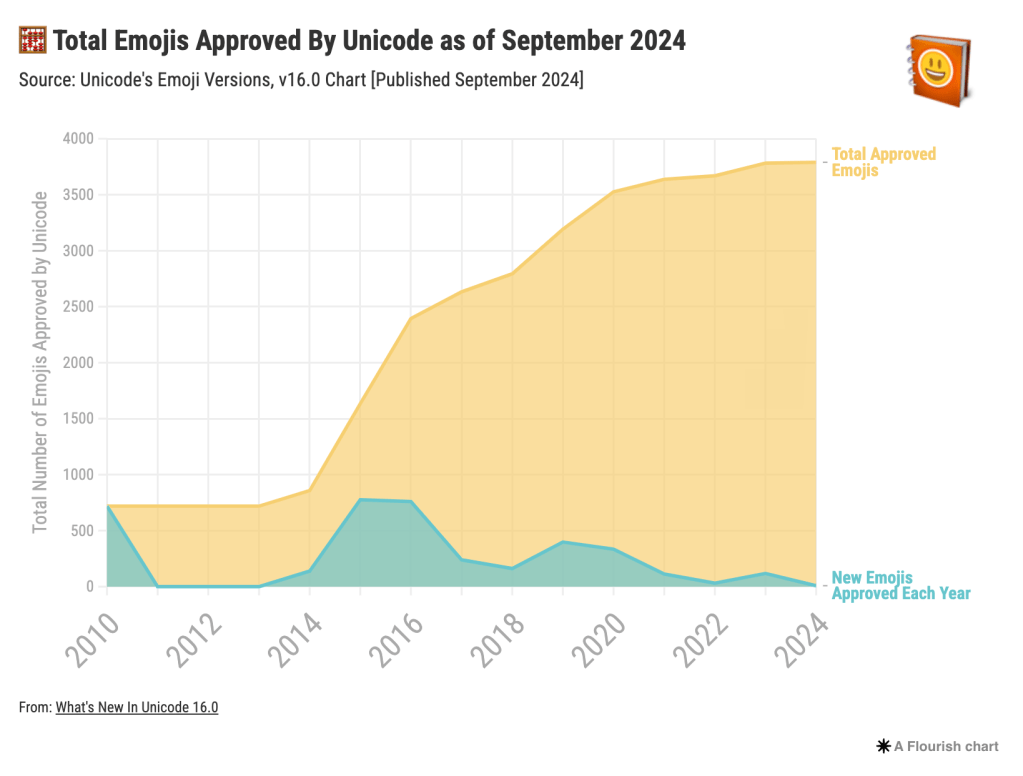
Unicode 16.0 is out! (Released on September 10, 2024)
This release adds a total of 5,185 new characters, bringing the overall character count to 154,998. One new addition is seven new scripts:
- Garay (West Africa)
- Gurung Khema (Northeast India/Nepal)
- Kirat Rai (Northeast India/Nepal)
- Ol Onal (Northeast India/Nepal)
- Sunuwar (Northeast India/Nepal)
- Todhri (Albania)
- Tulu-Tigalari (Southwest India)
3,995 additional Egyptian Hieroglyph characters were also added, along with eight new emoji (view, and more info, here):
- Face with Bags Under Eyes (I feel seen)
- Fingerprint
- Leafless Tree
- Root Vegetable
- Harp
- Shovel
- Splatter
- Flag: Sark
Perhaps even more significant are hundreds of new symbols from the “Symbols for Legacy Computing” block
This block was introduced in Unicode 13.0 (2020) with 212 characters. These symbols come from various home computers and gaming systems from the 1970s and 1980s, as well as Teletext broadcasting standards. Some of the systems represented include:
- Amstrad CPC
- MSX
- Mattel Aquarius
- RISC OS
- MouseText
- Atari ST
- TRS-80 Color Computer
- Oric
- Texas Instruments TI-99/4A
- TRS-80
- Minitel
- Teletext
- ATASCII
- PETSCII
- ZX80
- ZX81
The block includes various types of characters:
- Graphic characters specific to these legacy systems
- Semigraphics characters
- New block-shaped characters
- Line-drawing characters
- 60 “sextant” characters (semigraphic characters made up of six smaller blocks)
These additions help in accurately representing and preserving text and graphics from legacy computing systems. They also allow modern systems to display and process content from older systems more accurately. Some of these symbols are valuable for enthusiasts and researchers working with or emulating vintage computer systems. And, they represent an important time in computing history, including early home computers and video game systems that played a crucial role in the development of personal computing and gaming.
FIN
Remember, you can follow and interact with the full text of The Daily Drop’s free posts on Mastodon via @dailydrop.hrbrmstr.dev@dailydrop.hrbrmstr.dev ☮️
 hrbrmstr's Daily Drop
Leave a comment